
How a French Auditor Used Taxxa's AI to Review Three Appraisal Reports, Catch Hidden Errors, and Cut Costs to a Third


Francois Roux
CEO & Co-founder
The situation
Three individuals are contributing their shareholdings up into a holding company (apport de titres, a share-for-share contribution, a common step in French estate and tax structuring). Three contribution-appraisal reports must be drawn up, one per contributor, and under time pressure. The file is intricate: ownership is dismembered (démembrement, the civil-law split of full ownership into a usufruit, or usufruct, and a nue-propriété, or bare ownership) between two of the contributors; the shares are those of real estate companies (sociétés immobilières), with some thirty pages of valuation in the annexes; and the legal position differs from one contributor to the next. The temptation to duplicate the first report is strong. That is precisely where the risk lies.
The professional risk
These reports are destined for the court registry (greffe). A point passed over, an inconsistency between two derivative reports, an error in the angle of analysis: each is grounds for a complete rework or for rejection of the filing. And the author re-reading his own text against the clock is the least well placed to catch such flaws.
The method
The first report was drafted by hand. The contribution deed (traité d'apport), its valuation annexes, and the report in Word format were then submitted to Taxxa under an open-ended instruction: does the report hold up, and what is missing from it? The exercise was repeated for the two subsequent reports, including by deliberately submitting duplicated versions, and once more on all three reports considered together.
What Taxxa.ai detected
The findings fall into four categories.
- Typographical errors, present in all three reports and caught systematically.
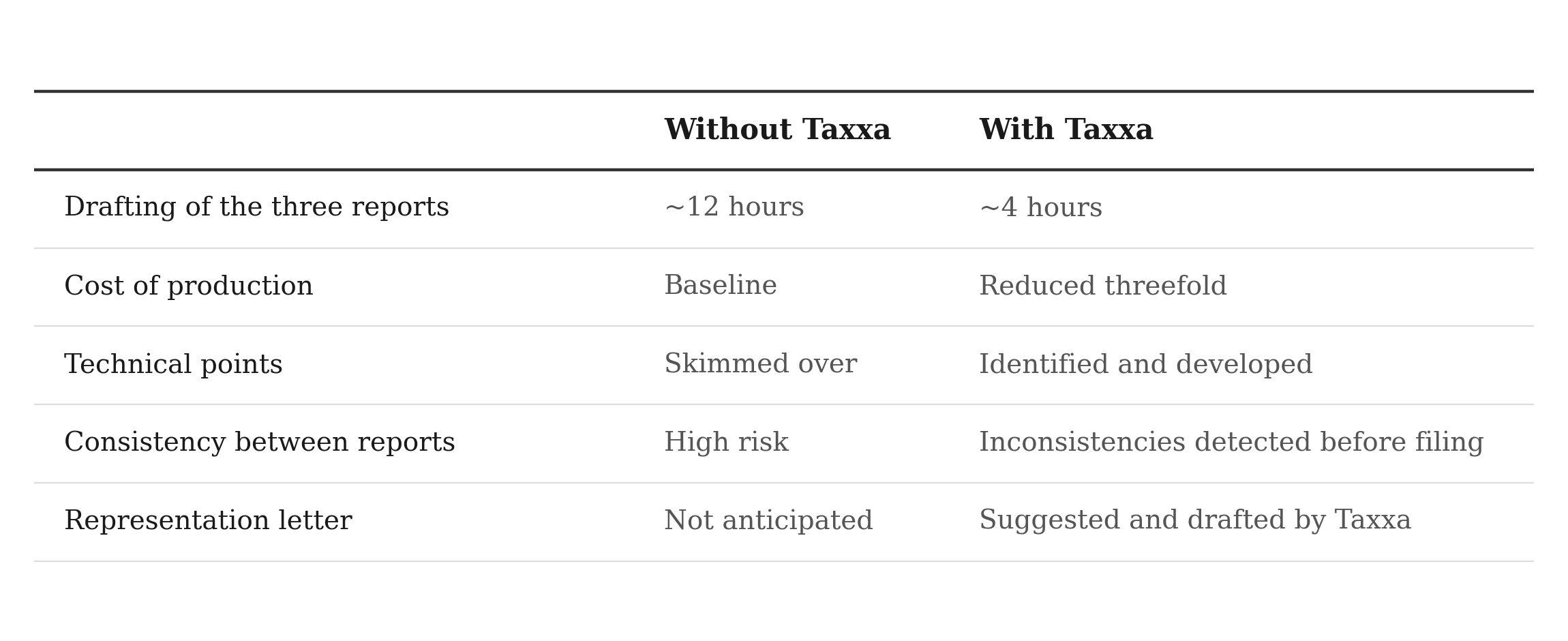
- Substantive points on the first report: the démembrement, the central difficulty of the file, had been skimmed over, and the property-valuation methods treated too superficially. Taxxa.ai produced a method-by-method summary and drafted the missing developments.
"Taxxa solution produced a remarkably concise analysis, treating each valuation method with a precision and rigor that time pressure would not have allowed one to achieve alone."
- Inconsistencies between reports: on the second report, passages concerning the usufruct and the démembrement had been carried over from the first, even though they were moot for that particular contributor.
- An error in the angle of analysis on the third report: the analysis had been conducted from the standpoint of the bare owner (nu-propriétaire) when in fact the contributor was the usufructuary (usufruitière); and three companies were referred to when the contribution concerned the shares of one alone.
An unsolicited deliverable
In the course of the review, Taxxa.ai proposed, of its own accord, that a representation letter (lettre d'affirmation, the equivalent of a management representation letter in an audit) be drawn up, and drafted one. The tool anticipated a need that the file called for, though no one had voiced it.
The takeaway
Submitting the contribution deed and its annexes together with the report allows Taxxa.ai to check the report against the file, rather than against itself. That is precisely what human review, under time pressure, cannot guarantee.
"The productivity gain was considerable. But beyond efficiency, it is the securing of the file that represents the most significant contribution."
Key Highlights
A note on one recurring term: under French company law, where assets other than cash are contributed to a company, an independent, court-appointed appraiser, the commissaire aux apports, must assess their value and report on it. The engagement itself is the commissariat aux apports, and the report is filed with the commercial-court registry.